22 min read
September 3, 2026
Black Friday has a habit of feeling like a November problem, but for ecommerce brands that are serious about Q4, the important decisions need to be made much earlier. By the time Black Friday arrives, you should already know what you want to sell, what you can afford to discount, how much stock you have, what you are prepared to spend and what needs to come back from that spend.
That matters even more in 2026 because the promotional calendar keeps creeping forward. Singles’ Day lands on 11 November, Fake Friday falls the week before Black Friday, early offers are appearing earlier every year, Black Friday itself is on Friday 27 November and Cyber Monday follows on Monday 30 November. Christmas trading starts almost immediately afterwards.
For an ecommerce business, that is not really a weekend anymore. It is a prolonged period where advertising costs, discounts, inventory commitments and customer demand all move at the same time, which can put a surprising amount of pressure on both profit and cash flow.
That is why our approach at The Ad Lounge would not start with “what discount are we doing?” or “how much should we increase the Google Ads budget?”. The better starting point is: how much cash are we putting into Q4, when do we get it back, and how much contribution profit should be left when the dust settles?
Revenue is relatively easy to buy during Black Friday. Profitable revenue is harder, and profitable growth that does not leave the business wondering where all the cash went in January is harder again.
The idea of Black Friday as a single weekend is becoming less useful. Customers are researching earlier, retailers are launching promotions earlier and paid-media competition starts building before the main Black Friday weekend itself.
For most UK ecommerce brands, I would look at the period from September through to Christmas as one connected trading cycle rather than a collection of isolated promotional dates. You do not necessarily need to run an offer at every point, but you should know how each date affects customer behaviour, competitor activity, stock and your own media plan.
The important thing about that calendar is not that it gives you more opportunities to discount. In many cases, the opposite is true.
If you start heavily discounting in early November, go again for Singles’ Day, extend the same promotion through Fake Friday, increase it for Black Friday and then find something new to shout about on Cyber Monday, you can spend most of November training customers not to pay full price. At the same time, you may be paying some of the highest acquisition costs of the year to sell those products at their lowest margins.
There will be brands where a long promotional period makes commercial sense, particularly where there is excess stock to clear or a deliberate customer-acquisition strategy behind it. But the point is that the offer should come from the economics of the business, rather than from a feeling that everyone else is running a sale so you should too.
This is where I think a lot of Black Friday planning starts to go wrong. A revenue target gets agreed first: perhaps the business did £250,000 last November and wants to do £350,000 this year. There is nothing wrong with wanting that growth, but the revenue number tells you very little about whether achieving it will actually improve the business.
Black Friday usually means some combination of lower selling prices, higher Paid Search spend, higher Paid Social spend, increased fulfilment volumes, additional shipping costs and potentially more returns. The business may also have committed significantly more cash to inventory months before any of those orders arrive.
Customer acquisition costs can also move in the wrong direction at exactly the point you want to scale. If that is already happening in your account, our guide to why ecommerce CAC is increasing and what to do about it goes into the reasons in more detail.
Put all of that together and it is entirely possible to have a record revenue month without a record profit month. In the wrong circumstances, the business can sell considerably more and actually make less.
That does not mean I would be conservative for the sake of it. If the economics are working, Black Friday can be exactly the right time to scale aggressively. The difference is that I would want to scale towards more contribution profit, rather than simply chasing the largest possible number at the top of Shopify.
We used the same principle when scaling Organic Bargains with Google Ads. Campaigns and product groups were aligned with contribution margin, AOV and product mix, allowing revenue to grow without treating platform ROAS as the only measure of success.
So instead of only asking “how much revenue did Black Friday generate?”, I would also want to know how much additional contribution profit we created from the additional money that went in.
Profit is only part of the picture because peak trading can put a surprising amount of pressure on cash flow. If you are expecting a large Q4, you may have ordered additional inventory months before the sales arrive, which can mean paying supplier deposits, settling balances, covering freight and potentially paying import costs before that stock has generated any revenue.
Once the stock arrives, the cash requirement does not stop. November comes around and you increase Paid Search and Paid Social budgets, so more money leaves the business before customer revenue starts coming back in. Orders then have to be fulfilled and some of them will eventually become refunds or returns.
That gap is why understanding your ecommerce cash conversion cycle matters so much during Black Friday. A product can be profitable on paper and still create a cash problem if you scale it faster than the business can fund the stock and acquisition required to support that growth.
This becomes even more important when the business is growing quickly. If doubling your advertising investment requires another £100,000 to be tied up across inventory and customer acquisition before that money returns as cash, that funding requirement needs to be understood before the media plan is approved.
It is also why CAC on its own does not tell the full story. The time it takes to recover that CAC matters as well. A £40 customer acquisition cost that is recovered immediately can have a very different impact on cash from a £40 CAC that only becomes profitable after a second purchase six months later.
If you want to understand the numbers behind this more clearly, the Ecommerce Profitability Playbook covers the wider relationship between acquisition costs, margins and profitable growth.
One of the easiest ways to get Black Friday wrong is to decide on the discount before modelling what it does to the economics of the order. A 25% discount sounds simple, but the impact on contribution profit can be considerably larger than 25% because many of your costs do not fall when the selling price does.
Take a deliberately simple example of a product that normally sells for £100. If there are £50 of variable costs associated with that order before advertising, you have £50 left at full price to cover acquisition and profit. Reduce the selling price to £75 and those £50 of costs do not suddenly disappear.
| Metric | Full Price | 25% Black Friday Discount |
|---|---|---|
| Selling price | £100 | £75 |
| Variable costs before advertising | £50 | £50 |
| Contribution before advertising | £50 | £25 |
| Contribution margin | 50% | 33% |
| First-order break-even ROAS | 2.0x | 3.0x |
In this example, you have reduced the selling price by 25%, but the amount available to pay for advertising and generate profit has fallen from £50 to £25. It has halved. Your first-order break-even ROAS has also moved from 2.0x to 3.0x, potentially at the same time that competition is pushing your acquisition costs higher.
Same product, same Google Ads account, completely different economics.
That is why I would model the promotion before approving it. For every important SKU or useful product group, I would want to understand the promotional selling price, COGS, fulfilment, fees, shipping contribution, expected returns, contribution margin, allowable CAC and break-even ROAS.
If those numbers are not currently clear, our Ecommerce Profitability Calculator is designed for exactly this. It takes the actual economics behind the order and calculates contribution margin, allowable CAC and break-even ROAS rather than asking you to pick a ROAS target because 4x happens to sound healthy.
A sitewide percentage discount is easy to communicate, but that does not automatically make it the best commercial offer. Depending on your margins, customer base and inventory position, a bundle, tiered spend threshold, free gift, shipping incentive or early-access offer may produce a stronger result without sacrificing as much margin.
The right answer can also vary by product. An overstocked category that has been tying up cash for months may justify a deeper discount because turning that inventory back into cash has genuine value. A high-margin bestseller with limited stock and plenty of organic demand may need very little incentive at all.
We have seen the consequences of promotion dependency in practice. When we started working with Shift, the brand had become reliant on an acquisition model built around heavy promotional activity. Moving towards a healthier full-price strategy helped reduce CPA and create a much more scalable channel.
The offer should therefore solve a commercial problem. It should not exist simply because every other ecommerce website has turned its homepage black and added a countdown timer.
Inventory should not live in a separate spreadsheet that the marketing team only sees when something sells out. If you are going to increase media spend materially during Black Friday, stock needs to be part of that decision because inventory is ultimately cash that has already left the business.
That changes how I would think about product priorities. If you are heavily overstocked on a product, accepting a slightly lower margin to convert that stock back into cash can be commercially sensible. If another product is likely to sell through at full price anyway, taking 30% off it and then paying Meta to sell it out faster may be doing a lot of work for very little benefit.
For the products we intend to push, I would want a simple view of contribution margin, current stock, inbound stock, sales velocity, expected promotional demand, conversion rate, paid-media performance and return rate. You do not need a 40-tab forecasting model, but you do need enough information to stop treating every SKU as though it has identical economics.
This product-level view is especially important for Google Shopping and Performance Max. In the Organic Bargains case study, better alignment between campaign structure, product mix and contribution margin allowed us to put more budget behind the areas capable of producing higher-quality revenue.
Once the commercial plan makes sense, you can decide what Paid Search should actually do. I would start at product level rather than looking exclusively at the headline ROAS of the account or Performance Max campaign.
Campaign-level reporting can hide a lot. One group of products may be generating excellent margins and have plenty of inventory available, while another quietly absorbs a meaningful proportion of the spend without producing much commercial value. The overall campaign can still look healthy enough to hide the problem.
Before Black Friday, I want to know which products are receiving spend, which products convert, which have the best contribution margins, which have the stock to scale and which are genuinely useful for acquiring new customers. If you cannot answer those questions from the current setup, I would fix that before deciding how much budget to add.
Our wider approach to Google Ads management is built around that principle: the platform needs to be connected to the commercial reality of the business rather than optimised in isolation.
Black Friday is also a bad time to discover that Merchant Center has disapproved your most important products, sale prices are not matching the website or half the useful product attributes are missing. Feed work is not particularly glamorous, but for ecommerce Paid Search, it is one of the foundations of performance.
I would review Merchant Center warnings and disapprovals, product titles, GTINs, categories, attributes, imagery, prices, availability, sale-price setup, promotions and landing pages. Where it is useful, custom labels can also bring commercial context such as margin, stock level, product priority or clearance status into the campaign structure.
We saw how important the foundations were when working with Pink Boutique. Recurring Shopping feed issues, inefficient budget allocation and an overly complicated account structure were limiting growth, so fixing the feed and rebuilding the account were important parts of getting performance back onto a stronger footing.
I would also want to understand how much of the Google Ads result is coming from people who already know the business. Brand traffic is not bad, and excluding it indiscriminately is not the answer either, but you should know what is driving the number you are looking at.
If the account reports an 8x ROAS during Black Friday but a large proportion of that revenue comes from existing customers searching the brand after receiving an email, that context matters before deciding Google deserves another £20,000. The important question is what incremental value the next bit of Paid Search investment is actually creating.
Paid Social has a slightly different job in the run-up to peak trading. September and October give you time to learn which products, messages and creative ideas people actually respond to before you need to scale them into a more competitive November auction.
I would test genuinely different creative concepts rather than producing ten cosmetic variations of essentially the same advert. Product demonstrations, founder-led content, customer proof, UGC-style creative, problem-and-solution concepts, gifting, self-purchase and bundle-led messaging can all tell you something different about why the customer might buy.
By late October, I would ideally have a reasonable understanding of which products are getting a response, which hooks are stopping people, which formats suit the product and which creative angles actually lead to sales. The Black Friday offer can then be layered onto ideas that have already shown some ability to sell, rather than becoming the entire creative strategy.
If you need more capacity on that side, our Digital Creative service is built around performance creative for paid channels, including native social formats, UGC-style assets, statics and structured messaging tests.
There is a useful example in our Shift Paid Social case study, where structured creative testing and a healthier offer helped reduce CPA while sales volume increased, without continuing to rely on the unsustainable promotional approach the brand had been using previously.
There is little point paying significantly more to send traffic to a website that becomes the limiting factor. Before November, I would go through the customer journey on an actual phone rather than approving everything from a desktop browser.
Land from an advert, find a product, choose a variant, add it to the basket, trigger the promotion, check the delivery information and complete the payment. Then repeat the process on another device. Problems with mobile navigation, unclear sizing, confusing discount rules, unexpected shipping costs or broken payment methods become considerably more expensive when thousands of extra visitors are arriving every day.
I would also look at AOV rather than concentrating exclusively on conversion rate. A useful bundle, relevant complementary product, sensible free-delivery threshold or premium variant can improve the economics of acquisition without requiring you to find another 10,000 visitors.
For higher-ticket products, the relationship between the advert and the wider buying journey becomes even more important. The Rowen Homes case study is a good example of how improving feeds, account structure, creative and funnel alignment can improve conversion performance on higher-value products.
Do not wait until Black Friday to discover that the purchase event has been firing twice, transaction values are wrong or Google Ads is optimising towards something you no longer consider a primary conversion. Run actual test orders before the promotional period and trace them through your ecommerce platform, GA4, Google Ads and Meta.
The numbers will not match perfectly across every platform, and they are not supposed to. Attribution models, conversion windows and reporting logic differ. I would generally treat ecommerce or finance data as the commercial truth for orders and revenue, while using the advertising platforms for optimisation and GA4 for wider journey analysis.
Above all of those systems, I would want one simple commercial view that includes total spend, net revenue, new customers, CAC, MER and contribution profit. When Google and Meta both claim the same customer, adding their reported revenue together does not magically create a second order.
If your current account and measurement setup cannot answer those commercial questions, the Profit Assessment will help identify where the gaps are across margins, value signals, account structure and profit-led reporting.
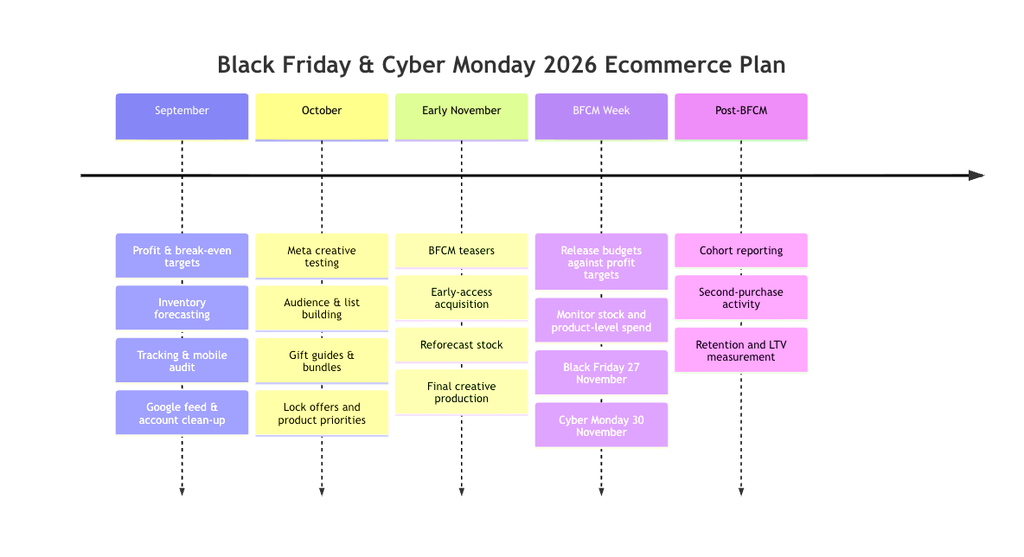
If I were sitting down with an ecommerce brand at the beginning of September, I would keep the planning process relatively simple. September is about knowing the numbers and fixing the foundations, October is about learning what works and locking the plan, and November is about executing without losing sight of cash and contribution profit.
Start with contribution margin, allowable CAC and break-even ROAS at both normal and proposed promotional prices. If those numbers are not currently available, use the Ecommerce Profitability Calculator before you start discussing media budgets.
At the same time, review your Q4 cash requirement, product priorities and inventory position. Audit Merchant Center, tracking and the mobile customer journey, and start testing the Meta creative you may want to scale later.
By October, the commercial plan should start becoming an execution plan. The promotional strategy needs to be locked, early-access and first-party audiences should be growing, important Google Shopping feed work should be complete and website changes should be moving towards completion.
This is also the month where I want creative winners to start emerging. By the end of October, I would rather have a smaller number of proven concepts ready to adapt for Black Friday than 30 completely untested sale ads waiting in a folder.
November is when Singles’ Day, Fake Friday, Black Friday and Cyber Monday start colliding with one another. At this stage, the goal should be controlled scaling rather than inventing the strategy as you go.
Release more budget when demand, margin, stock and contribution profit justify it. Pull back where acquisition costs move beyond the level the business can support, or where you are paying to accelerate products that are likely to sell out anyway.
Most importantly, decide the rules before the pressure arrives. Know what would make you increase spend, what would make you hold it and what would make you cut it.
There are hundreds of Black Friday checklists that tell you to update your homepage and post on social media. For an ecommerce business spending meaningful money on Google and Meta, I would care much more about the commercial and operational checks below.
For more on how we manage this side of ecommerce growth, see our Paid Search services and dedicated Google Ads service.
Our Paid Social service covers Meta, TikTok and Pinterest, while Digital Creative covers the performance assets needed to support those campaigns.
Do not acquire thousands of discounted customers and then effectively forget about them on 1 December. Black Friday becomes much more useful when you treat the customer cohort as something you can learn from rather than simply a pile of November orders.
Create a BFCM 2026 customer cohort and keep it intact. Over the following 30, 60 and 90 days, look at how many were genuinely new customers, what their first-order contribution looked like, which products they bought, how many refunded and how many returned for another purchase.
I would also compare the quality of customers acquired through different channels and entry products. A customer who looks expensive on the first order can still be excellent if they repay the acquisition cost quickly and go on to purchase again, while an apparently cheap customer can be far less attractive if the initial order is low margin and they never return.
That analysis is what starts to tell you how much you may be willing to pay for a similar customer in 2027. It also gives next year’s Black Friday planning a much better starting point than simply saying “last year did a 4.5x ROAS”.
I would not necessarily expect your prettiest platform ROAS of the year while you are acquiring customers aggressively at peak scale, and I would not necessarily want it. At some point, protecting an 8x ROAS can become another way of saying that you did not take the profitable growth that was available.
Equally, “it’s Black Friday” is not an excuse to throw normal commercial discipline out of the window. The right amount of spend is the point where the next bit of budget still produces an acceptable commercial return.
So the question I care about is not simply “what ROAS did Black Friday do?”. It is “did putting the next £5,000 into Black Friday create more contribution profit?” If it did, there may have been room to scale further. If it did not, a larger revenue number is unlikely to fix the economics underneath it.
That is why I would rather know the margin, allowable CAC, break-even ROAS, cash requirement, stock position and product priorities before peak trading begins. Trying to work out whether you are profitable while the account is already spending £1,000 an hour is not my idea of a particularly relaxing Friday.
If you do not know what CAC or ROAS your business can actually afford, start with our Ecommerce Profitability Calculator. If the bigger question is whether your Google and Meta setup is actually aligned with profitable growth, take the Profit Assessment.
You can also see how we apply the same thinking to live ecommerce accounts across our paid media case studies.
There is no secret Performance Max setting, Meta audience or magic discount that suddenly makes Black Friday work. Most of it comes down to doing the slightly boring work early enough: know the margin, understand the cash cycle, know the products and stock, fix the feed, test the creative, sort the website, check the tracking and agree what has to come back from every additional pound you spend.
Then when Black Friday arrives, you are making decisions from a plan rather than trying to invent one while Google, Meta, your customers and your warehouse are all moving considerably faster than usual.
If you want another pair of eyes on the numbers or media strategy before peak trading, get in touch with The Ad Lounge.